Slightly Off the Grid

(aka Maywood Living)


Not a bee, not a yellow jacket, and why is it out at night?

Enormous “bees” bounce off the glass of our front door.  Dozens of them.  Unlike moths, which flit annoying around light, or June bugs, which bump clumsily against the glass, these look threatening, like mutant yellow-jackets.   They are so big they make a wasp look like a mosquito.  They scare me.

Yes.  They scare me.  Me, beekeeper wife, who takes a cocktail down to the bee-yard to relax while watching honeybees come and go; who can calmly keep reading on the porch even though I am allergic to the black wasp on the screen; who takes pictures of her hubby petting bumblebees and smiles at grandson who does the same.

European Hornet, over an inch long. This one has already taken the oil bath.

So now dozens of them are bouncing off the front door.   We turn off the interior hall light to stop attracting them.  This is not a permanent solution, however.   I refuse to live in a dark house because of a few insects.  I tell John he has to do something.
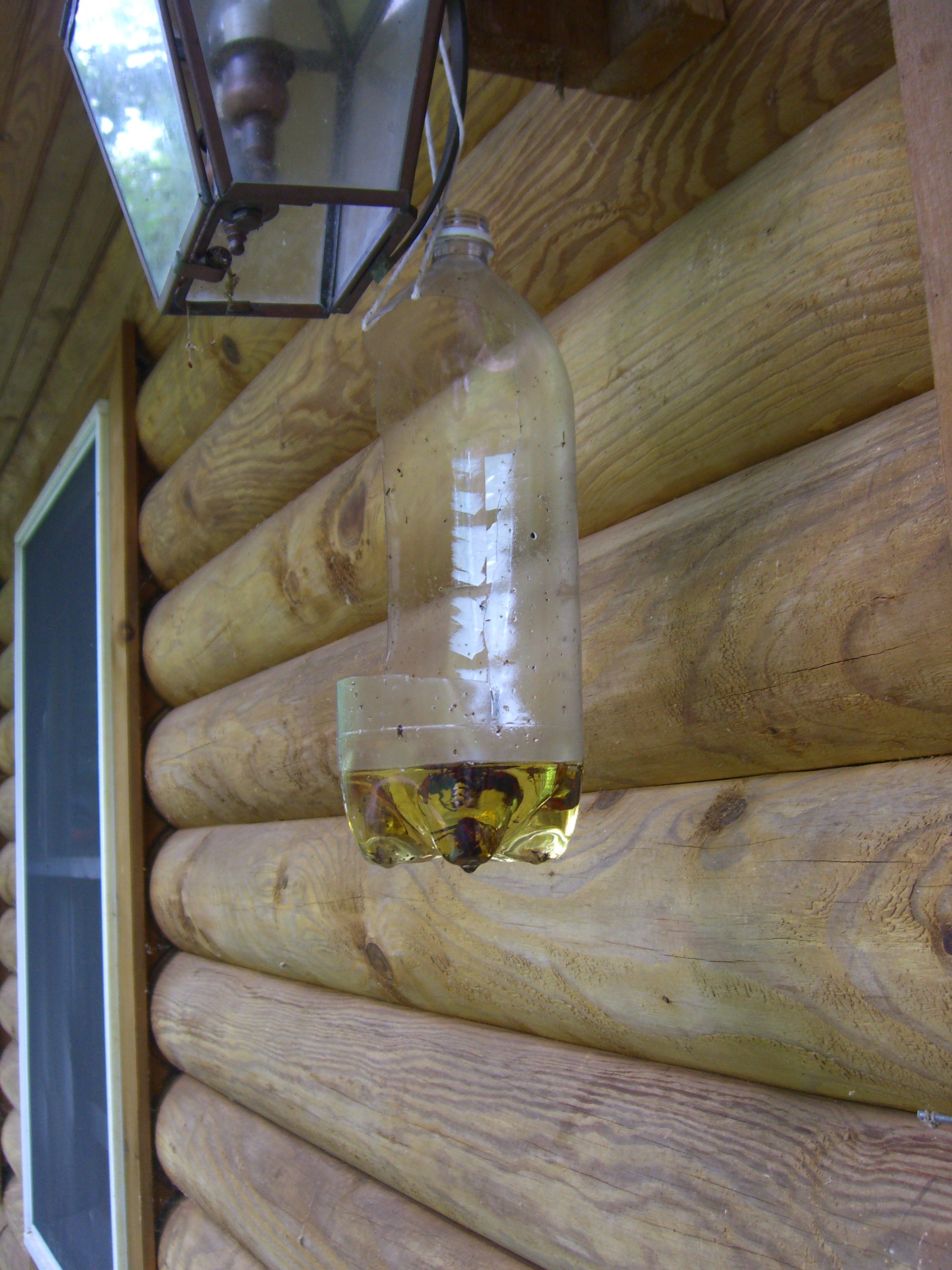
John used an unobtrusive clear soda bottle…and he even took the label off!

Not knowing what they are or where they nest, the best John can do is kill the ones who show up at our door.  He resurrects his bug-catching invention that he devised years ago to catch live insects for our frogs Frieda and Franny.  The contraption involves cutting an opening in the side of a two liter soda bottle and hanging the bottle from an outside light.  The insects are attracted to the light, bounce off the soda bottle and fall in.  John’s original live bug trap added an aluminum light-reflecting shield (aka, a sliced open beer can).  This time we want the bugs to die.  John fills the bottle with a couple of inches of vegetable oil, thinking that the bugs can drown in it.

The front light goes on.  The hall light goes out.  And we wait. (Well, we go watch tv and check from time to time.)  Unlike moths, they don’t show up immediately.  It isn’t until about 10 p.m. that we notice activity around the light…and a soda bottle filling up with the dead.   As it turns out, they die as soon as they come in contact with the oil.  The next morning, John tosses the marinated bugs into the woods and some critter comes along later to eat them.  Ah…the circle of life.  I love it–as long as I’m not the one in the circle.

A bit of internet research identifies our flying monsters as European Hornets.  The only true hornet.  They were introduced to the U.S. in the mid-to late 1800’s.  I do not know if they were invited or if they crashed our garden party, but they are here now, and happily ensconced all over the East Coast.

Although they look like big yellow-jackets, they do not eat human food and are not a threat to barbecues.  They will not hide in your open soda can.  They eat live insects like crickets and cicadas.   They are not attracted to the porch light per se; they are attracted to the other things that are attracted to the porch light.  They’re just showing up where the action is.  They eat many insects that truly are considered pests.  In Germany, they are a protected species.  Good thing we are not in Germany.
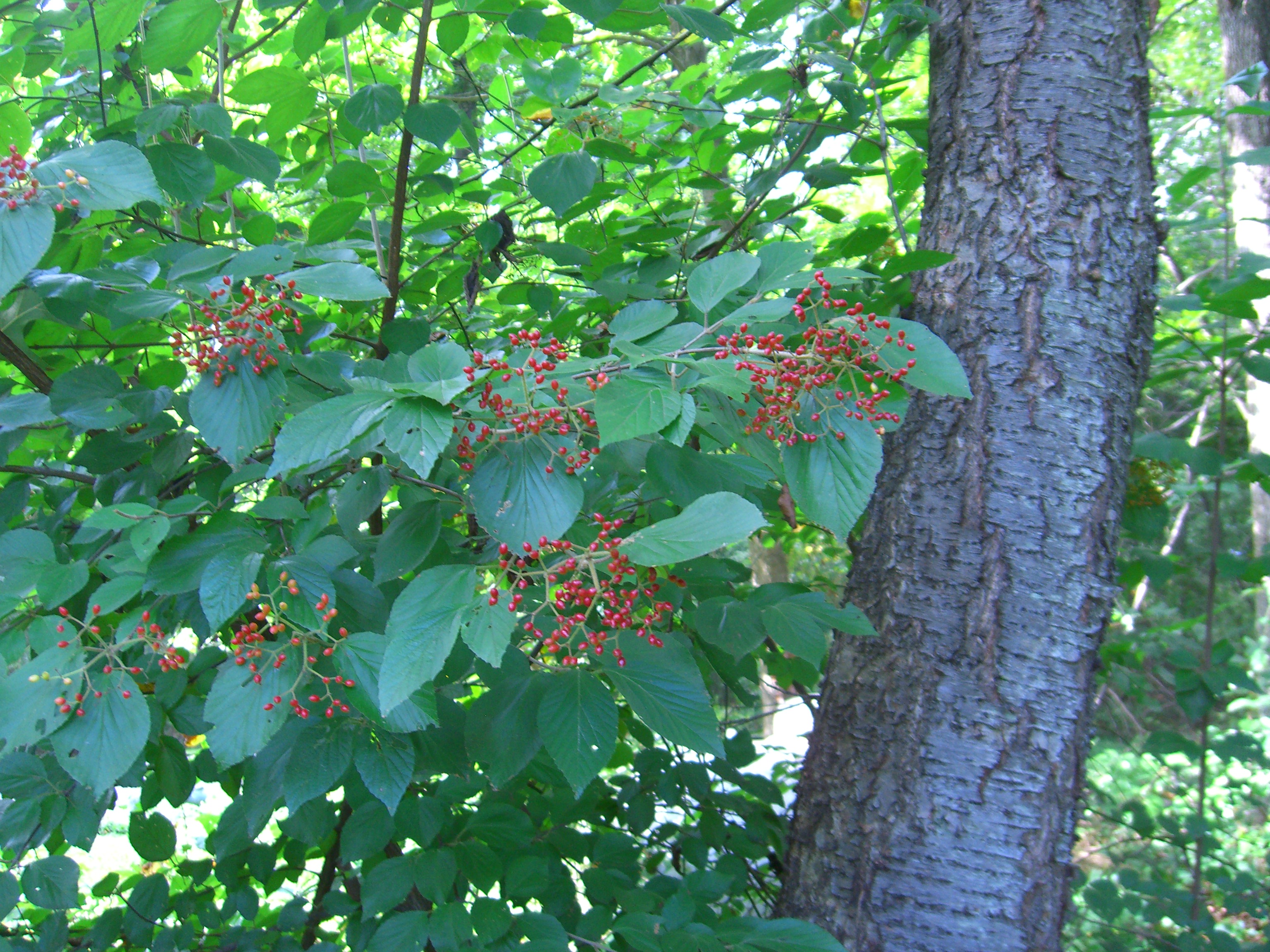
I know where the red viburnum is.  As for the hornets nest…

Unlike honeybees, who give their lives with a single sting, hornets can sting repeatedly and the European Hornet has a nasty big stinger.  Fortunately, they are rather shy and really not aggressive–unless they are defending their nest.  The problem is–we don’t know where the nest is.  They nest in the woods at least six feet off the ground, but they have been known to nest in exterior house walls.  At this time of year, late summer into fall, the colony could range in size from 300 to 1000 hornets.  Homeowners with a nest in the house are urged to call a professional exterminator.  These hornets are tricky and will create new escapes if one tries to block their entrance or spray it.  The last thing anyone wants is a few hundred of these things inside the house.

I know they are not nesting in our solid log walls.  No saying what nooks and crannies they may have found though.  But John says he used to see these way back when he was building the house…so they’ve been here since before the house.  Most likely, they have a nest in the woods, a teeny tiny flight to our front door.

With cold weather, the drones will die off leaving the queen to care for the brood over the winter.  Until then, we’ll be preparing marinated hornets for some unknown creature in the woods.

This mantis is praying that we’ll leave him alone.


29 responses to “Not a bee, not a yellow jacket, and why is it out at night?”

  1. This is EXACTLY the information I’ve been searching for! I’ve only seen them twice. Once it came straight for my flashlight when I was out closing the coop windows. It sounded mean.

    Love you’re writing style!

    Liked by 1 person

  2. This is now 2024 and the HUGE bee’s are still at it coming on the porch at night and inside my home I learned what they were from this post so thank you for keeping it up.

    Like

  3. I live in a wooded yard attacbed to a large 200 acre

    woods bere in North Carolina. I saw these huge ‘ bees’

    for the first time this year…after living here for 24 yrs.

    They took over some carpenter bees’ post holes in my

    dogs’ yard. They wouldn’t let me in the gate! Now here

    at night, buzzing LOUDLY. I will use the oil trick, as I am

    allergic to the stings, & I’m old. Not how I want to go!

    Like

  4. Can somebody please post a picture of what their nest looks like? I want to go hunting.

    Like

  5. Have lived in our new home for 4 years, but last night was the first time I’ve seen these things after we accidentally left the back porch light on for a few hours. There were 20-50 of them buzzing around. The tennis racket isn’t really effective because they fly erratically and that makes them hard to swat. I guess I need to start carving up some 2-liter bottles. But, if they are attracted to a blue light, why can’t I use an actual bug zapper?

    Like

    1. They are attracted to the bug zappers, I have about ten of those suckers stuck to my bug zapper (fried).

      Liked by 1 person

    2. I went out on my back porch and when the door opened two out of the five flew into the utility room. I had a partial can of wasp and hornet killer that I got from Tractor supply the day before. I went around and came back in my front door and was able to hit both of them with a shot. Thankfully , it took them down.

      Like

  6. We’ve gotten them this year in Attalla Alabama, center of 100 wooded acres. These guys are huge and nasty, and living in the top of the tree above our front porch; the only way I could find out anything about them was to look up, “bees that come out at night”, 😣 they are terrifying, freaks me out, we have an 18 month old son.

    Like

  7. They actually are attracted to lights, and have a very nasty sting.

    The only time I’ve had an anaphylactic reaction from a bee or wasp sting was one time at summer camp when they were flying around a lantern and one flew over to me and stung me in the back.

    They fly up to the windows of my house at night, and a couple of days ago I even saw two of them flying around those yellow bug lights that aren’t supposed to attract bugs. There weren’t any other bugs flying around the lights.

    Like

  8. European hornets can wipe out a lot of your honeybees! They will catch them in midair and land somewhere to eat them and then back to the cycle again. Some of you have your bees confused. European hornets can sting and, I know from experience, they hurt like hell!!! They usually nest together in the hollow part of a tree usually by way of a knothole. Cicada Killers are usually as big or a little bit larger than the European Hornet and they are more black unlike the hornet which is yellow. They don’t nest together and cannot sting you. They usually bore a hole in the ground and leave the mound of dirt beside the opening of the hole. A couple of years ago I had 4 of them in my front yard(live next to a river). I’ve watched them drag their cicada catch down in their holes many times. I’m having a problem with the European Hornets now. Can’t get in our pool at night(pool light on) without a dozen or so landing in the water and floating around stuck in water. So if your pool pests are the yellow ones BE CAREFUL!!!!

    Like

    1. By the way. Here in South Carolina we still call them Japanese Hornets. Now I just hope I don’t see any of those Killer Hornets anytime soon!! They look 👀 like Bumblebee in the Transformers movie!!😀

      Like

  9. The first time we saw them we lived in a mobile home set back in the woods. We would see hundreds of them after dark hitting the front door where the light was. Scary! I picked one up that had died sometime during the night but I couldn’t find out what it was in the books at the time…we didn’t have internet. I remember ours being slightly orange in color.

    Like

  10. Recently I have seen these giant hornets around my porch light. I actually heard them before I saw them. They sound like a hummingbird is near-by (or perhaps a small helicopter.) Thank you for sharing this helpful information. They freak me out but I’m happy to learn about my doorway enemy. I decided to turn the light off.

    Like

    1. They do have a loud buzz. One got in the house yesterday—attracted to the ceiling light in the mudroom. Hubby zapped it with our bug zapper “tennis” racket. We don’t like them because they can prey on our honeybees.

      Like

      1. I got stung in the hand by my back door last summer just before dark. When it first hit my hand I thought it was a cicada because of how large it felt. Than it stung me and my whole hand and arm swelled up. I had shooting pains that shot up and down my arm for 24hrs! That night it hurt so bad I couldn’t fall asleep even with ice wrapped around it. It was just awful. I’ve been stung by several different wasps and bees growing up playing in the woods, but nothing ever felt like this. I almost went to the ER. So BE CAREFUL!

        Like

  11. Thank you for the good information. I also have these big guys hanging out around my porch light this season. We’ve spotted a gray papery hive high up in a two story rhododendron but it may belong to another group of flying zappers! They sure are intimidating given they resemble yellow jackets on steroids.

    Like

  12. Dorothy Grimmer Avatar
    Dorothy Grimmer

    I see these comments have been in 2012 – it is now 2017, and we have this same problem with the European Hornets. They stung a friend at our pool party last week, and three came into the house – it was terrible! I hate to kill them, but I do not like them raining on our parade either. Do you still do the vegetable oil trap? We cannot find their nest – we live on 11 acres, mostly forest. Any advice?

    Like

    1. We actually haven’t had a problem with them since that year. I’ll see one once in a while, but not hovering around the door at night. We did fumigate the attic/soffit area which killed all sorts of pests. I can’t even remember now if the hornet was one of them. I think it was. Our current issue is normal old black wasps. Hubby has taken to using a peppermint essential oil spray on them and the carpenter bees. Non-toxic to pets and humans. And we have our favorite bug-zapper racket for when they get on the porch or inside. For you, the soda bottle trap hung by a light by your pool will get a lot, but until you find the nest (with its queen), they will still be around. One of the joys of country living! 😳

      Like

  13. In Georgia we call them “cicada killers”, nice to know the correct name. I’ve seen one carry a dead cicada over double the size of itself! Scary.

    Like

    1. Cicada killers are a different species of wasp. They’re long and black and don’t usually bother people.

      Like

  14. I live in northeast Ohio. Usually 1 or 2 European hornets show up around my Florencant light in my garage every night starting in mid July.. I’ve killed a few. Seems there’s always another to take its place.. Hope they don’t have a nest in my attic..

    Like

    1. I hope not, too! We haven’t had a problem with the Europeans hornets lately, but there are plenty of other pests out here in the woods!

      Like

  15. They were numerous in north Alabama but seem to have almost died out .

    Like

  16. Thank you so much for this information! We live in the Hereford Zone and have these guys coming to our deck (light areas, yes..) and being so large and out at night, couldn’t figure out who they were and what they wanted. We love bees, beneficials, that is. My kids were all bumble bee petting since they could walk, yet…seeing THESE HUGE YIKES ones….my husband and son wanted to kill them (of course! lol) So glad to know they are really beneficial and will tell my family and neighbors about what I learned here. They do seem to be going into our roof into the house so that may turn into a problem…but at least they are keeping the yellow jacket population down! Thanks again! Great information!

    Like

    1. Beneficial or not, the idea that they could sting repeatedly does freak me out. At least they come out after I go inside at night.

      Like

  17. charltonestatetrust Avatar
    charltonestatetrust

    simple yet effective!

    Like

  18. I saw one a couple weeks ago at the pool and the “lifeguard” went CRAZY . . . the maintainence man came by and said they were harmless but it sure was the biggest hornet I have ever seen…….

    Like

  19. we’ve seen those things…i wondered what they were…leave it to the grand duchess to teach me about them!

    Like

Leave a reply to Ashley Cancel reply